The best foods for erectile dysfunction are the ones that keep blood flowing freely: watermelon, beetroot and leafy greens like palak and methi, garlic, fruits such as amla, pomegranate and jamun, nuts and seeds, dal, and oily fish like mackerel or sardines. Your overall eating pattern matters more than any single food, and diet supports treatment rather than replacing it.
If your erections have become weaker or less reliable, you are not alone, and in most men it is treatable. Erectile dysfunction (ED), which some people still call impotence, is very common, and your plate is one of the easiest places to start.
This guide covers how food affects erections, 12 Indian foods worth eating, what to cut down on, a simple veg and non-veg diet chart, what the evidence really says about ashwagandha, shilajit and "natural Viagra", and the signs that tell you diet alone is not enough.
How does food affect your erections?
An erection depends on blood flowing freely into the penis, and what you eat decides how healthy your blood vessels are and how much nitric oxide your body makes. Nitric oxide is the natural chemical that relaxes those vessels so blood can rush in.
Blood flow and nitric oxide, in plain words
When you are aroused, nerves send a signal to the penis. The thin inner lining of the blood vessels there (doctors call it the endothelium) releases nitric oxide. This relaxes the muscle in the vessel walls, the arteries widen, and the spongy tissue of the penis fills with blood. As it fills, it presses on the veins that would normally drain the blood away, and that keeps the erection firm.
Anything that damages that inner lining weakens this chain. High blood sugar, high blood pressure, high cholesterol, smoking and long-term inflammation all do exactly that. The arteries in the penis are much narrower than the ones that supply the heart, so when blood vessels start to suffer, erections are often one of the first things to change.
Food works on the same chain from the other side. Some foods give your body the raw material for nitric oxide (nitrates from greens and beetroot, L-arginine and citrulline from nuts, dal and watermelon). Others protect the vessel lining from damage (flavonoids and other antioxidants in fruit and vegetables, omega-3 fats in fish and walnuts). Fibre-rich foods keep blood sugar and weight in check, which protects the vessels over years.

What the research shows
Two large, long-running studies of men in the United States give the clearest picture so far.
- Eating pattern: a study that followed 21,469 men for about 10 years (JAMA Network Open, 2020) found that men under 60 who ate the most Mediterranean-style diet had a 22% lower risk of developing ED than men who ate it the least. The link was weaker in older men.
- Flavonoid-rich fruit: a study of 25,096 men followed for 10 years (American Journal of Clinical Nutrition, 2016) found that men who ate the most of three types of flavonoids had a 9 to 11% lower chance of developing ED. Men who ate the most fruit overall had a 14% lower risk, and the benefit was clearest in men under 70.
These are observational studies, so they show a strong link rather than proof that food alone prevents ED. But they fit everything doctors know about heart and blood vessel health, and the same diet also lowers your risk of diabetes, heart attack and stroke.
"Mediterranean" does not mean you need olive oil and Italian food. The pattern is simple: lots of vegetables, fruit, dal and beans, whole grains, nuts, some fish, little red or processed meat, and cooking in plant oils. A home-cooked Indian thali with dal, sabzi, roti and salad, cooked in mustard, groundnut or til oil, already follows most of it.
The reverse is also true. A diet heavy in fried snacks, maida, sugar and processed food leads to weight gain, diabetes, high blood pressure and high cholesterol. Each of these damages the same small blood vessels that erections depend on.
Is diet the only reason for erection problems?
No. Diet is one of several causes, and often not the main one, which is why the right fix depends on finding your cause first.
About 1 in 4 men struggle with ED and PE, and the same weak or unreliable erection can come from very different places:
- Nutrition and weight: a diet high in fried food, sugar and maida, and extra weight around the belly.
- Hormones: low testosterone or a thyroid problem, which can lower both desire and erection quality.
- Stress, anxiety and poor sleep: work pressure, relationship strain or worry about performance can block an erection even when the body is healthy.
- Habits: smoking, heavy drinking and gutkha or khaini all damage blood vessels.
- Medical conditions: diabetes, high blood pressure and high cholesterol, and sometimes the medicines used to treat them.
Often more than one of these is at work. A man with diabetes who also sleeps badly and worries about performance needs more than a change of diet. You can read more in our complete guide to erection problems and their causes, and if your blood sugar is high, see how diabetes affects erections.
This is the way we work at Raaz MD. Instead of handing every man the same pills, our doctors first look for the root cause, whether that is food and weight, hormones, stress and sleep, habits or an underlying condition. Across more than 50,000 doctor consultations, that one step is what most often decides whether a plan works.
Not sure which of these is behind your erection problems? Take the free, private Men's Test. It takes about 2 minutes and helps point to your likely cause, so you are not guessing.
Which foods help with erectile dysfunction?
The most useful foods are rich in nitrates, flavonoids, omega-3 fats, L-arginine and zinc. Leafy greens, beetroot, watermelon, fruit, nuts, dal, oily fish and whole grains all support the blood flow and hormone balance that a strong erection depends on.
Here are 12 foods and food groups that are easy to find in India, with a simple way to eat each one.
1. Watermelon (citrulline)
Watermelon (tarbooz) contains citrulline, which the body turns into L-arginine and then into nitric oxide. It is also mostly water and low in calories, which makes it a good swap for sweets in summer.
How to eat it: a bowl as a mid-morning snack. The white part near the rind has plenty of citrulline too, and in parts of Rajasthan and Gujarat it is cooked as a sabzi.
2. Beetroot, palak, methi and moringa leaves (nitrates)
Beetroot and leafy greens are among the richest sources of dietary nitrate, which the body converts into nitric oxide. Beetroot juice is well known for lowering blood pressure a little, and better blood pressure means healthier arteries.
How to eat it: palak dal, methi thepla or methi paratha made with little oil, sarson ka saag, chaulai (amaranth), drumstick (moringa) leaves in dal or poriyal, and a beetroot and carrot salad or beetroot raita a few times a week.
3. Garlic and onion
Garlic (lahsun) and onion contain sulphur compounds and flavonoids that support blood vessel relaxation and can help blood pressure and cholesterol slightly. Cleveland Clinic lists both among foods that support erections.
How to eat it: you already use them in tadka. Add raw onion to salads and chaat. If you are on a blood thinner, check with your doctor before taking garlic capsules, though normal cooking amounts are fine.
4. Amla, oranges and other citrus fruits
Citrus fruits are rich in flavanones, one of the flavonoid types linked to an 11% lower chance of ED in the 2016 study above. Amla (Indian gooseberry) is one of the richest natural sources of vitamin C, an antioxidant that helps protect the vessel lining.
How to eat it: a whole orange, mosambi or kinnow daily, lemon squeezed over dal and salads, and raw amla or amla chutney. Amla murabba is soaked in sugar, so keep it occasional.
5. Pomegranate, jamun and berries (flavonoids)
Dark red, purple and blue fruits are rich in anthocyanins, which were linked to a 9% lower chance of ED. Pomegranate (anaar) is also rich in other polyphenols, although a small trial of pomegranate juice in men with mild ED did not give a clear answer.
How to eat it: jamun in season, pomegranate seeds on raita or salad, black grapes, and strawberries in winter. Choose the whole fruit over packaged juice, which has little fibre and often added sugar.
6. Dark chocolate and cocoa
Cocoa is rich in flavanols, which help blood vessels widen. The benefit comes from the cocoa, not the sugar, so ordinary milk chocolate does not count.
How to eat it: a small square or two of dark chocolate with 70% cocoa or more, a few times a week, as a replacement for mithai rather than an extra.
7. Oily fish: mackerel (bangda), sardines (mathi), salmon
Oily fish is the best food source of omega-3 fats (EPA and DHA). They lower triglycerides, calm inflammation and help keep blood vessels flexible. Mackerel, sardines, hilsa and salmon are rich in them. Popular river fish like rohu and katla are good lean protein, but they are not rich omega-3 sources.
How to eat it: fish twice a week, grilled, steamed, baked or in a light curry. Rava-fried or deep-fried fish loses much of the benefit.

8. Nuts and seeds: walnuts, almonds, pistachios, flaxseed, pumpkin seeds
Nuts and seeds give you healthy fats, L-arginine, magnesium and vitamin E. Walnuts and flaxseed (alsi) also contain a plant form of omega-3, which makes them especially useful for vegetarians. Pumpkin seeds add zinc.
How to eat it: a handful (about 30 g) of plain, unsalted nuts a day, and a spoon of roasted, ground flaxseed on curd, dalia or in roti dough. Salted, fried or sugar-coated nuts undo much of the good.
9. Dal, rajma and chana
Lentils, beans and chickpeas give you plant protein, fibre, folate and L-arginine. Their fibre slows the rise in blood sugar after meals, which protects blood vessels, and legumes are a core part of the Mediterranean-style pattern linked to lower ED risk in the 2020 study.
How to eat it: one or two bowls of dal a day, rajma or chole a few times a week, sprouts chaat as a snack, and moong dal chilla for breakfast.
10. Whole grains and millets: oats, bajra, ragi
Whole grains keep their fibre, B vitamins and minerals. They help with weight and blood sugar control, two of the biggest drivers of ED in Indian men. Maida and large helpings of white rice do the opposite.
How to eat it: bajra, jowar or ragi roti a few days a week, atta roti with the bran left in, dalia or vegetable oats for breakfast, and brown rice or a mix of white and brown if you love rice.
11. Eggs, pumpkin seeds and other zinc-rich foods
Zinc is needed to make testosterone, and a real deficiency can lower it. Eating enough zinc from food helps keep hormones in balance. Extra zinc beyond what you need does not raise testosterone further, so supplements only make sense if a doctor finds you are low. Our guide to natural ways to support testosterone covers the rest of the picture.
How to eat it: eggs, chicken, fish, pumpkin seeds, til (sesame), cashews, chana, curd and paneer. Oysters are famously rich in zinc, but you do not need them.
12. Vitamin D: sunlight, eggs and fish
Vitamin D helps keep blood vessels and testosterone levels healthy, and several studies have linked low vitamin D with ED. Low vitamin D is common in India even in sunny cities, because many of us spend most daylight hours indoors.
How to get it: some time in morning sunlight with your arms uncovered, plus eggs, oily fish and fortified milk. If you often feel tired or have body aches, ask your doctor about a simple blood test before taking vitamin D tablets.
Tea, coffee, and what if you also have PE?
Tea and coffee are fine in moderation. Green tea and plain chai with little sugar are better choices than sweet, milky tea many times a day. If early ejaculation bothers you along with erections, the diet overlaps a lot, and we cover the extra points in foods that may help with premature ejaculation.
The 12 foods at a glance
| Food | Indian options | How it helps |
|---|---|---|
| Watermelon | Tarbooz, rind sabzi | Citrulline for nitric oxide |
| Nitrate vegetables | Beetroot, palak, methi, sarson, chaulai, moringa leaves | Nitrates for nitric oxide, lower BP |
| Garlic and onion | Tadka, raw onion salad | Supports vessel relaxation |
| Citrus and amla | Orange, mosambi, kinnow, nimbu, amla | Flavanones and vitamin C |
| Dark fruits | Pomegranate, jamun, black grapes, strawberries | Anthocyanins protect vessels |
| Dark chocolate | 70% cocoa or more, small piece | Cocoa flavanols widen vessels |
| Oily fish | Bangda, mathi, hilsa, salmon | Omega-3, less inflammation |
| Nuts and seeds | Walnuts, almonds, pistachios, alsi, pumpkin seeds | Healthy fats, L-arginine |
| Legumes | Moong, masoor, rajma, chana, sprouts | Fibre, protein, steady blood sugar |
| Whole grains | Bajra, jowar, ragi, oats, dalia | Fibre, weight and sugar control |
| Zinc foods | Eggs, til, chana, cashews, paneer | Supports testosterone |
| Vitamin D sources | Morning sun, eggs, fish, fortified milk | Vessel and hormone health |
Which foods make erectile dysfunction worse?
Fried snacks, maida and sugary mithai, sweet drinks, processed meat, vanaspati and heavy drinking all damage blood vessels over time. Very salty pickles, papad and namkeen raise blood pressure, which also hurts erections.
These are the everyday Indian foods most worth cutting down:
- Deep-fried snacks such as samosa, pakora, bhature, kachori and chips. They are high in calories, and oil that is reheated again and again forms harmful trans fats.
- Maida and sugar in mithai, biscuits, rusk, white bread and bakery items. They cause sharp blood sugar spikes and, over years, raise your risk of diabetes.
- Sugary drinks such as cold drinks, packaged juices, energy drinks and sweet lassi every day. Liquid sugar adds belly fat quickly.
- Processed meat such as sausages, salami and packaged kebabs. They are heavy in salt and saturated fat.
- Vanaspati (dalda) and other hydrogenated fats. These are a major source of trans fat, the worst kind for arteries.
- Large amounts of ghee, butter, cream and malai. A teaspoon of ghee on your dal is fine. Rich, creamy gravies every day are not.
- Very salty foods such as achaar, papad, namkeen and instant noodles. Too much salt raises blood pressure, and here is how high blood pressure affects erections.
- Heavy drinking. Alcohol can stop an erection on the night itself, and heavy drinking over years harms nerves, the liver and testosterone levels. Read more on how alcohol affects erections.
Tobacco is a habit, not a food, but it belongs on this list. Smoking and chewing gutkha, khaini or paan masala narrow blood vessels directly. See whether smoking causes erectile dysfunction and how gutkha and tobacco affect erections if you use any of them.
You do not need to give up everything at once. Pick the two items you eat most often from this list and cut them by half this month. Small changes you can keep going beat a strict diet you drop after a week.
What does an Indian diet chart for erectile dysfunction look like?
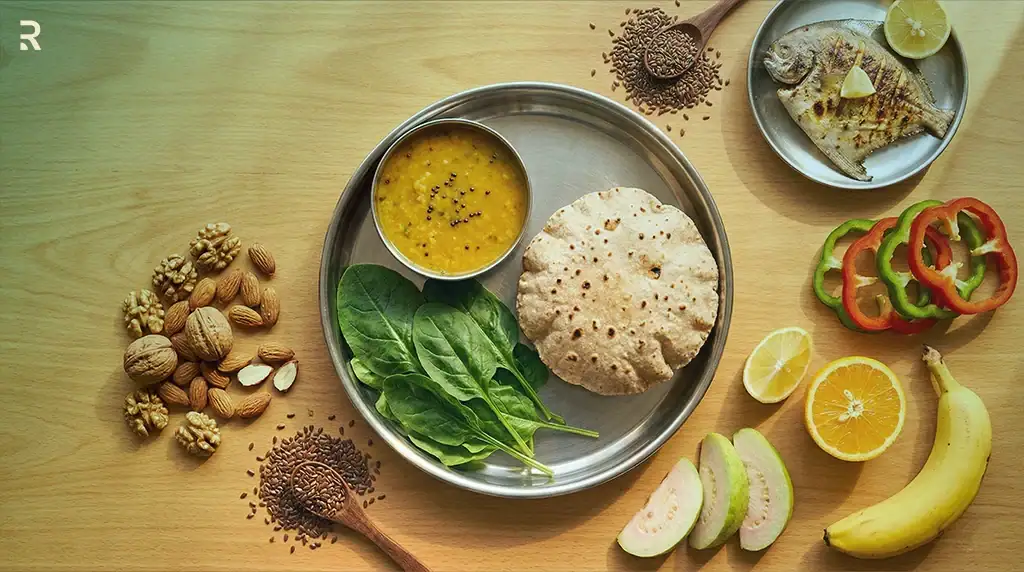
Build it around a normal thali: dal or rajma, a leafy sabzi, roti or millet, curd and salad, with grilled fish, eggs or paneer for protein. Snack on fruit and a handful of nuts instead of fried or sugary food, and cook in mustard, groundnut or til oil rather than vanaspati.
This matches the Dietary Guidelines for Indians (ICMR-National Institute of Nutrition, 2024), which ask for more vegetables, fruit, legumes and whole grains, and less salt, sugar, oil and ultra-processed food. What is good for your heart is good for your erections.

A sample day: vegetarian and non-vegetarian
This is a sample, not a strict diet chart. Rotate the options across the week, and adjust portions to your hunger, weight and activity. If you have diabetes or kidney disease, ask your doctor or a dietitian to adjust it for you.
| Meal | Vegetarian | Non-vegetarian |
|---|---|---|
| Early morning | A glass of water, 4 to 5 soaked almonds and 2 walnuts | A glass of water, 4 to 5 soaked almonds and 2 walnuts |
| Breakfast | 2 moong dal chillas with mint chutney, or vegetable oats, or ragi dosa; 1 orange | 2-egg omelette with spinach and onion, 1 multigrain roti or toast; 1 orange |
| Mid-morning | A bowl of watermelon or guava, or a glass of buttermilk | A bowl of watermelon or guava, or a glass of buttermilk |
| Lunch | 2 bajra or atta rotis, palak dal or rajma, mixed sabzi, beetroot and cucumber salad, curd | 2 rotis or a small bowl of rice, mackerel or sardine curry with little oil, methi sabzi, salad |
| Evening | Roasted chana or makhana, green tea or chai with little sugar | Sprouts chaat or roasted chana, green tea or chai with little sugar |
| Dinner | 1 or 2 jowar rotis, paneer or tofu bhurji with peppers, lauki or palak sabzi, a small bowl of pomegranate | 1 or 2 rotis, grilled chicken tikka or egg curry, sauteed greens, a small bowl of pomegranate |
Try to eat dinner two to three hours before bed, and keep it lighter than lunch. A very heavy, oily dinner leaves you sluggish, and that rarely helps in the bedroom.
Vegetarian and Jain-friendly options
A vegetarian diet can support erections very well. Get protein from dal, rajma, chana, paneer, curd and soy, and plant omega-3 from walnuts and flaxseed. If you eat no fish at all, a daily handful of walnuts and a spoon of alsi matter even more.
If you follow a Jain diet, you will skip onion, garlic and root vegetables such as beetroot and carrot. You can still cover the key nutrients:
- Nitrates from leafy greens like palak and methi.
- Flavonoids from pomegranate, amla, oranges, grapes and jamun.
- Healthy fats, L-arginine and zinc from nuts, pumpkin seeds, til and flaxseed.
- Protein and fibre from moong, masoor, chana and millets, with curd and paneer.
Five simple swaps for an Indian kitchen
- Grill, bake or air-fry instead of deep-frying fish, paneer and snacks.
- Fruit or a piece of dark chocolate instead of mithai after meals.
- Millet roti a few days a week instead of only wheat or white rice.
- A handful of nuts or roasted chana instead of namkeen with evening tea.
- Buttermilk, nimbu pani or plain water instead of cold drinks and packaged juice.
How long before you notice a difference?
Food works slowly. A Cleveland Clinic urologist says men may see improvement within a few weeks to a few months, as circulation gets better. How much it helps depends on your cause: if ED comes mainly from weight, sugar or cholesterol, diet has more to work on than if the cause is hormonal or linked to stress.
If nothing has improved after two to three months of real changes, do not keep waiting. That is the point to get checked.
What else should you change alongside food?
- Move every day. Brisk walking, cycling, swimming or sports improve blood flow and help your body use sugar better. Our guide to exercises that improve erections and stamina includes pelvic floor (Kegel) exercises too.
- Lose extra belly fat. Even a small drop in waist size can help erections, blood pressure and blood sugar.
- Sleep 7 to 8 hours. Testosterone levels rise during sleep, so regular short nights can pull them down, and poor sleep also raises stress hormones.
- Stop smoking and gutkha, and keep alcohol low. These undo much of what a good diet does.
- Drink enough water through the day. It will not fix ED, but it supports general health.
Do ayurvedic foods and supplements like ashwagandha or shilajit help?
The evidence is weak: in a 2011 trial of men with stress-related erectile dysfunction, ashwagandha did no better than a placebo, and shilajit has no good human studies for ED. Unregulated products can also contain heavy metals, so buy carefully and tell your doctor what you take.
Many Indian men try desi remedies before they see a doctor, and that is understandable. Here is what the research actually says, without hype or fear.
Ashwagandha: what the trials actually show
The best test of ashwagandha for ED is a randomised, placebo-controlled trial published in the journal Ayu in 2011. Eighty-six men with psychogenic ED (ED linked to stress or anxiety) completed 60 days of either ashwagandha root powder or a dummy powder. The ashwagandha group improved by 12.6% and the placebo group by 19.1%, with no real difference between them. The authors concluded that neither gave meaningful relief.
A newer 2025 study from Mumbai gave ashwagandha root extract to 100 healthy men aged 30 to 50 for eight weeks. It reported better scores for sexual desire, orgasm and satisfaction, and better semen results. But these were healthy men, not men with ED, and the study did not show a benefit for erections.
So ashwagandha may have some role in stress and general well-being, but it has not been shown to treat ED. It can also interact with thyroid, diabetes and sleeping medicines, and rare cases of liver injury have been reported with supplements. Ask your doctor before starting it.
Shilajit, safed musli, kesar milk and makhana
- Shilajit: there are no good human trials showing it treats ED. Raw or poorly purified shilajit can carry heavy metals and fungal contamination.
- Safed musli: the research is mostly in animals. There is no reliable evidence in men with ED.
- Kesar (saffron) milk: a pleasant, traditional drink. A few small studies of saffron and sexual function have given mixed results, so treat it as a comfort drink, not a treatment.
- Makhana (fox nuts): a light, nutritious snack and a great swap for namkeen when roasted with little oil. It has no proven effect on erections.
Is watermelon really "natural Viagra"?
Watermelon earns this name because of citrulline. In a small 2011 study of 24 men with mild ED, published in the journal Urology, a month of citrulline supplements improved erection hardness from mild ED to normal in 50% of men, compared with 8.3% on placebo. The researchers noted it worked less well than prescription ED medicines.
That study used a concentrated supplement. A normal bowl of watermelon gives much less citrulline, so enjoy it as healthy support, not as a replacement for treatment.
Why neem-hakeem mixtures can be risky
Unlabelled powders, "desi Viagra" capsules and roadside mixtures are where the real danger lies. A JAMA study of ayurvedic medicines bought online (2008) tested 193 products and found that about 1 in 5 (20.7%) contained detectable lead, mercury or arsenic. Products made in India and in the US were both affected, and every product with metals exceeded at least one safety limit.
Some "herbal" sex products sold with instant-result claims have also been found to contain hidden prescription drugs such as sildenafil. For a man who takes nitrate medicines for chest pain, that combination can drop blood pressure dangerously.
If you want to use an ayurvedic product, buy a labelled one from a licensed pharmacy, avoid anything promising instant or permanent results, and tell your doctor what you are taking.
Food myths many Indian men believe
A lot of food advice about sex in India is passed on by friends, relatives or roadside clinics. Here is how the common beliefs hold up.
| What people say | What the evidence says |
|---|---|
| Desi ghee and dry-fruit laddoos build "taakat" for sex | They are nutritious but very high in calories. A little is fine; a lot adds weight, which works against erections. |
| Eggs, meat and fish are "garam" and cause weakness | No evidence. Eggs and fish give protein, zinc, vitamin D and omega-3 fats that support erections. |
| Vegetarian men cannot have strong erections | Not true. A well-planned veg diet with dal, nuts, seeds, greens and fruit supports erections well. |
| Soya chunks and tofu lower testosterone | Reviews that pooled many trials found normal amounts of soy food do not lower testosterone in men. |
| Chhuhara (dried dates) in milk at night cures ED | A traditional, nourishing drink, but no study shows it treats ED, and it is high in sugar. |
| One strong powder can fix it permanently | No food or herb does this. Unlabelled powders may contain heavy metals or hidden drugs. |
When should you see a doctor?
See a doctor if erection problems last more than a few weeks, start suddenly, or come with chest pain, breathlessness or low sex drive. ED can be an early warning sign of heart disease, so it is worth getting checked even if you feel otherwise healthy.
Book a consultation if any of these apply to you:
- Erection problems have lasted more than a few weeks, or keep getting worse.
- Two to three months of better eating and exercise have not helped.
- The problem started suddenly, or after starting a new medicine.
- You have diabetes, high blood pressure, high cholesterol or a thyroid problem.
- You also have chest pain, breathlessness on climbing stairs, or pain in your legs when walking.
- Your sex drive has dropped, or you feel constantly tired or low.
- Worry about sex is affecting your mood or your relationship.
Why the heart matters: ED and heart disease share the same causes, including high blood pressure, high cholesterol, diabetes, smoking and extra weight. Because the arteries in the penis are small, they can show damage before heart arteries do. The US National Institutes of Health notes that ED may be a symptom of another health problem, so a check-up can catch something important early.
A good doctor will look for the root cause, which usually means asking about your health and habits and checking blood sugar, cholesterol, blood pressure, and sometimes testosterone and thyroid levels. Depending on the cause, treatment may include medicines such as sildenafil or tadalafil, taken only on a doctor's prescription. You can read how ED medicines like sildenafil work before you speak to one.
If you already take an ED medicine, two food points matter. The US National Library of Medicine's MedlinePlus advises talking to your doctor about grapefruit and grapefruit juice, and notes that a high-fat meal makes sildenafil take longer to start working. Never combine ED medicines with nitrate medicines for chest pain.
What should you do next?
Food is a real, useful part of fixing erection problems. More greens, fruit, dal, nuts, whole grains and oily fish, and less fried food, sugar, alcohol and tobacco, will help your blood vessels, your heart and your erections together.
But food works best when you know what you are fixing. If your erections have not improved, or you simply want to know your cause, start with the free Men's Test. It is private, takes about 2 minutes, and helps a doctor find what is really behind the problem, so your plan fits you instead of being a guess.
Frequently asked questions
Can diet alone cure erectile dysfunction?
Usually not on its own, and no honest doctor will promise that. A heart-healthy diet improves blood flow and lowers your risk. In a large US study of 21,469 men, those under 60 who ate the most Mediterranean-style diet had about 22% lower ED risk. If the cause is hormonal, psychological, diabetes-related or linked to medicines, food helps but will not be enough without proper treatment.
Which Indian food works like natural Viagra?
No food works like a prescription medicine. Watermelon is often called "natural Viagra" because it contains citrulline, which the body uses to make nitric oxide. In a small study of 24 men with mild ED, a citrulline supplement improved erection hardness, but a normal serving of fruit gives much less. Treat watermelon, pomegranate and leafy greens as long-term support, not a quick fix.
Which fruit is best for erectile dysfunction?
Watermelon, pomegranate, jamun and other berries, amla and citrus fruits like oranges are all good choices. They are rich in flavonoids, vitamin C or citrulline, which support healthy blood vessels. A study of over 25,000 men found that those who ate the most of certain flavonoids had a 9 to 11% lower chance of developing ED. A regular mix of fruits matters more than any single one.
Are dry fruits, dates and seeds good for erectile dysfunction?
Walnuts, almonds, pistachios and seeds like flaxseed and pumpkin seeds are a good daily habit. They provide healthy fats, L-arginine and zinc, which support blood flow and hormone health. Dates are nutritious but high in natural sugar, so eat two or three rather than a bowlful, especially if you have diabetes. Choose plain, unsalted nuts, since fried, salted or sugar-coated ones undo much of the benefit.
What should I drink if I have erectile dysfunction?
Water through the day, plain chaas, green tea, and coffee or tea in moderation are sensible choices. Pomegranate or beetroot juice can fit in occasionally, though a trial of pomegranate juice in men with mild ED did not show a clear, statistically significant benefit. The drinks to cut are alcohol, sugary cold drinks and packaged juices, which harm blood vessels and blood sugar over time.
Is it safe to eat these foods if I take ED medicine?
Almost all of them, yes. Two things to know. Grapefruit and grapefruit juice can interact with ED medicines such as sildenafil and tadalafil, so ask your doctor before having them. A very heavy, fatty meal can also slow down how quickly some of these medicines work. Take ED medicines only on a doctor's prescription, and tell your doctor about any supplements you use.