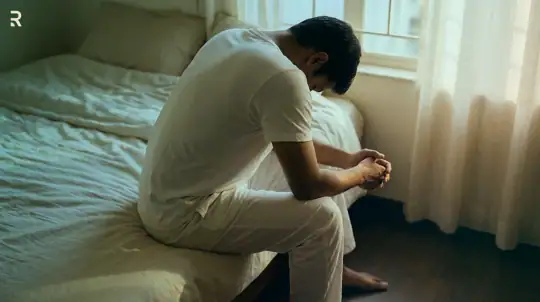
Yoga for nightfall works best as a calming daily routine, not a switch. Nightfall is normal, so no pose stops it completely, but Vajrasana, Ashwini Mudra, leg raises and slow breathing can lower stress, improve sleep and strengthen the pelvic floor, which many men find makes episodes less frequent and far less worrying.
In this guide, we walk you through five asanas and two mudras step by step, what the research honestly says, the myths that cause most of the worry, and the few signs that mean you should get checked. For the wider picture, start with our guide to nightfall: when it is normal and what helps.
Does yoga help with nightfall?
Yoga cannot stop nightfall, and it does not need to, because nightfall is a normal part of male sleep. What it can do is calm your mind, improve your sleep and train your pelvic floor, and many men find that makes nightfall less frequent and much less stressful.
Most men who search for this are not ill. They are usually in their teens or twenties, they wake up to a wet patch more often than they would like, and somebody (a friend, a relative, a video, a roadside clinic poster) has told them it is draining their strength. The worry is often the bigger problem than the nightfall itself.
What yoga can and cannot do
- It can lower day-to-day stress and anxiety, which often make sleep lighter and more broken.
- It can build a steady bedtime routine, so you fall asleep calmer instead of scrolling your phone.
- It can strengthen and give you better awareness of the pelvic floor muscles, the same muscles involved in ejaculation.
- It can make you feel more in control of your body, which by itself eases a lot of the guilt around nightfall.
- It cannot guarantee that nightfall will stop, reduce it to a fixed number, or "cure" something that is not a disease.
- It cannot replace a doctor if you have pain, blood in the semen, burning or discharge.
What the research actually says
To be honest with you: no clinical trial has tested yoga specifically for nightfall. Anyone who tells you a pose is "proven" to stop it is overselling.
The closest evidence comes from a related problem. A 2025 systematic review and meta-analysis by doctors at AIIMS Rishikesh pooled studies on yoga for premature ejaculation and found a clear positive effect, with no significant side effects in the yoga groups. The authors suggest it may work through stress reduction, calmer nervous system activity and pelvic floor strengthening. They also note the studies were small and varied, so larger trials are needed.
A 2023 study that placed muscle sensors near the pelvic floor found that some yoga poses activate these muscles strongly, with the locust pose reaching about 63.5% of a maximum voluntary squeeze (Blagg and Bolgla, 2023). That tells us yoga really does work the muscles involved in ejaculation. It does not prove that working them changes nightfall. We think that honesty matters more than a promise.
Why does nightfall happen, and when is it normal?
Nightfall (also called nocturnal emission, wet dreams or swapndosh) is an ejaculation during sleep, and 70 to 90% of men experience it, usually starting at 13 or 14. It can happen with or without a sexual dream and is not a disease.
When it starts and how often it happens
The largest recent look at the subject is a 2026 scoping review in Sexual Medicine Reviews that pulled together 157 sources (Maiolino and colleagues, 2026). It found:
- The first episode usually happens between 12.6 and 15.6 years of age, most often at 13 to 14.
- Between 70% and 90% of males experience it, especially in adolescence.
- Reliable data on how often it "should" happen are scarce and inconsistent. In practice, some men rarely have it and others have it often, and both can be normal.
- Hormonal influences appear modest, so nightfall is not a sign of a hormone problem on its own.
- Misconceptions are widespread, particularly in South Asia, where nightfall is central to the fear of "dhat" or semen loss.
It is most common in the teens and twenties and often becomes less frequent with age, or once a man has a regular sex life. There is no single number of episodes a week that separates normal from abnormal.
Why the "excess semen" explanation is outdated
You may have been told that nightfall is the body "throwing out extra semen" when it has nowhere else to go. The 2026 review found that the evidence does not support this old overflow idea. Nightfall appears to be a reflex of the sleeping body, one that can occur even without input from the brain's conscious control. In simple words: it is not a leak, a loss or a sign that something is filling up and overflowing.
What can make it feel more frequent
Nightfall is not caused by one thing, but some factors can make episodes more noticeable or make you worry about them more:
- Stress and anxiety: exams, job pressure, marriage talk at home, or worry about nightfall itself.
- Poor or broken sleep: late nights, irregular timings, a phone in bed until 2 am.
- Strong arousal just before sleep: watching porn or sexual content in bed.
- Some medicines: rarely, a new medicine can change sexual function, including ejaculation during sleep. Never stop a prescribed medicine on your own; ask the doctor who prescribed it.
The Raaz view: find what is really bothering you
At Raaz, we see the same pattern again and again. A man comes in worried about nightfall, and when a doctor talks to him properly, the real concern turns out to be something else: stress that is ruining his sleep, anxiety about marriage, or a problem during sex such as finishing too quickly or weak erections. Those problems have different root causes in different men: stress and sleep, habits like smoking, alcohol and gutkha, low testosterone or a thyroid problem, or conditions like diabetes, blood pressure and high cholesterol. That is why handing everyone the same pill (or the same "dhatu" capsule) does not work. For the full picture, read our guide on what causes nightfall and how it is treated.
Not sure why yours feels so frequent, or whether something else is going on? The free Men's Test takes about 2 minutes, is completely private, and helps you see what may be behind it.
Which yoga practices help with nightfall? 7, step by step
A simple routine of Vajrasana, Padmasana, Ashwini Mudra, Vajroli Mudra, Ardha Uttanpadasana, Bhujangasana and Paschimottanasana takes about 15 minutes a day. The two mudras work the pelvic floor directly; the asanas build core strength and help you relax before sleep.
Do them on an empty or light stomach (Vajrasana is the one exception, and is best after dinner). Move slowly, breathe through your nose, and stop any pose that causes pain.
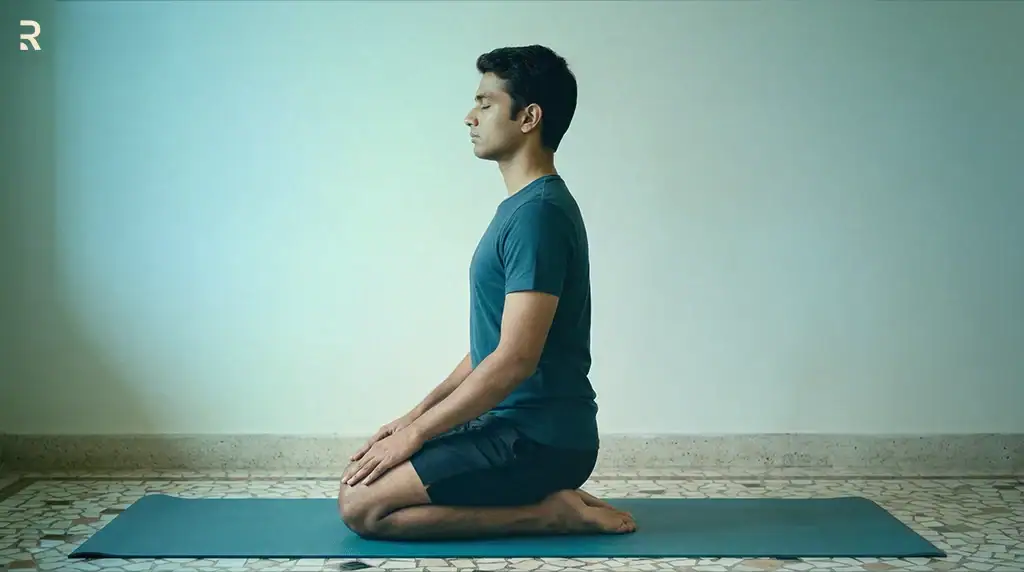
1. Vajrasana (Thunderbolt Pose)
- Kneel on a folded mat or blanket with your knees together.
- Sit back on your heels, big toes touching and heels slightly apart.
- Keep your spine tall, shoulders relaxed and hands resting on your thighs or knees.
- Close your eyes and breathe slowly through your nose.
- Stay for 3 to 5 minutes to begin with, building up to 10 minutes.
Hold: 5 to 10 minutes, ideally after dinner. Safety: place a cushion between your buttocks and heels if your knees or ankles hurt, and skip it if you have a knee injury.
Why it may help: it is one of the few poses traditionally done after a meal, and it gives you a quiet, screen-free few minutes before bed, which helps you wind down.
2. Padmasana (Lotus Pose) with slow breathing

- Sit on the mat with your legs stretched out.
- Bend your right knee and place the right foot on your left thigh, then place the left foot on your right thigh.
- If full lotus strains your knees, use Sukhasana (simple cross-legged sitting) instead. It works just as well for this routine.
- Rest your hands on your knees, straighten your back and close your eyes.
- For bedtime breathing, try Anulom Vilom (alternate nostril breathing): close the right nostril with your thumb and breathe in through the left, then close the left and breathe out through the right. Breathe in through the right, switch, and breathe out through the left. That is one round.
- Or try Bhramari (humming bee breath): breathe in deeply, then hum softly with your lips closed as you breathe out.
Hold: 3 to 5 minutes of slow breathing, best in the last half hour before sleep. Safety: never force your knees into lotus; switch to Sukhasana if you feel any knee pain.
Why it may help: slow, steady breathing is one of the simplest ways to calm a racing mind at night. This is also the seated base for the two mudras below.
3. Ashwini Mudra (Horse Gesture)
- Sit in Padmasana, Sukhasana or Vajrasana with a straight back.
- Breathe normally; do not hold your breath.
- Tighten the muscles around your anus, as if holding back a bowel movement.
- Hold the squeeze for 2 to 3 seconds.
- Release completely and relax for the same time.
- Repeat 10 to 20 times. That is one round.
Reps: 2 to 3 rounds a day. Safety: skip it during painful piles or a fissure, or after recent anal or pelvic surgery, until your doctor says it is fine.
Why it may help: it trains the pelvic floor, including the pubococcygeus (PC) muscle, which plays a part in ejaculation. The release matters as much as the squeeze: you want strong muscles that can also relax.
4. Vajroli Mudra
- Sit in Padmasana or Sukhasana with your hands on your knees and eyes closed.
- Take a long, deep breath in through your nose.
- Hold the breath gently for a few seconds.
- While holding, draw the area between your anus and scrotum upwards and inwards, the feeling of stopping the flow of urine.
- Hold only as long as is comfortable, then breathe out slowly and release the muscles.
- Repeat 10 to 15 times.
Reps: 10 to 15 rounds. Safety: practise it on its own, never while actually passing urine. If you have high blood pressure or a heart condition, skip the breath hold and just breathe normally while you squeeze.
Why it may help: it targets the muscles closer to the base of the penis, so it builds the kind of awareness that many men later use for better control during sex.
5. Ardha Uttanpadasana (One-Leg Raise)

- Lie flat on your back with your arms by your sides, palms down.
- Press your lower back gently into the mat.
- Breathe in and slowly lift your right leg, keeping the knee straight, to a height you can control (30 to 60 degrees is plenty).
- Hold for 10 to 20 seconds while breathing normally.
- Breathe out and lower the leg slowly. Repeat with the left leg.
- Once this feels easy, raise both legs together (full Uttanpadasana).
Reps: 3 to 5 per leg. Safety: avoid it if you have a hernia, recent abdominal surgery or a slipped disc; bend the other knee and keep the foot on the floor if your back aches.
Why it may help: it strengthens the lower abdomen and core, which work together with the pelvic floor.
6. Bhujangasana (Cobra Pose)

- Lie on your stomach with your legs together and the tops of your feet on the mat.
- Place your palms under your shoulders, elbows bent and close to your body.
- Keep your lower belly and hips on the floor.
- Breathe in and slowly lift your head and chest, looking ahead with a long neck.
- Breathe steadily, then breathe out and lower yourself down.
Hold: 30 seconds at first, building slowly to 1 minute, 2 to 3 times. Safety: keep your elbows slightly bent if your lower back pinches; avoid it with a recent back injury or hernia.
Optional progression, Shalabhasana (Locust Pose): lie face down with arms by your sides, then lift your chest and both legs off the mat together for 10 to 20 seconds. In the 2023 muscle-sensor study, locust activated the pelvic floor more than any other pose tested.
Why it may help: it opens the chest, strengthens the back and, with locust, gives the pelvic floor a real workout.
7. Paschimottanasana (Seated Forward Bend)
- Sit with your legs straight out in front of you and your head in line with your spine.
- Breathe in and raise both arms, lengthening your back.
- Breathe out and fold forward from the hips, keeping the spine long rather than rounding it straight away.
- Hold your shins, ankles or feet, wherever you comfortably reach.
- Relax into the stretch and keep breathing out slowly.
Hold: 20 to 30 seconds, building to 1 minute. Safety: bend your knees if your hamstrings are tight, and avoid deep folds with a slipped disc or sciatica.
Why it may help: forward bends are traditionally calming, and stretching the back of the body is a good way to release the day's tension before sleep.
A 15-minute daily routine
You do not need an hour. Consistency matters far more than intensity, so aim for this every day for six to eight weeks.
| Practice | Hold or reps | Best time |
|---|---|---|
| Ardha Uttanpadasana | 3 to 5 per leg, 10 to 20 seconds each | Morning or evening, empty stomach |
| Bhujangasana (or locust) | 2 to 3 holds of 30 seconds to 1 minute | Morning or evening, empty stomach |
| Paschimottanasana | 2 holds of 30 seconds to 1 minute | Morning or evening, empty stomach |
| Ashwini Mudra | 2 to 3 rounds of 10 to 20 squeezes | Any time, seated |
| Vajroli Mudra | 10 to 15 rounds | Any time, seated |
| Vajrasana | 5 to 10 minutes | After dinner |
| Anulom Vilom or Bhramari in Padmasana | 3 to 5 minutes | Last half hour before sleep |
Keep a simple diary: note your sleep time, your stress level and any nightfall. After a few weeks, judge the overall trend, not a single night.
Do Kegel exercises help with nightfall?
Kegels train the same pelvic floor muscles as Ashwini and Vajroli Mudra and are safe to do daily. They are known to help ejaculation control during sex, but no study shows they stop nightfall, and there is no evidence they cause it either.
Think of Kegels as the medical cousin of the two mudras: you find the muscle you would use to stop the flow of urine, squeeze it, hold briefly and relax. Our guide to step-by-step Kegel exercises for men shows exactly how to find the right muscle and build up safely.
Many men worry after searching "kegel exercise se nightfall hota hai" or noticing an episode soon after they start. That is almost always coincidence, because nightfall was going to happen from time to time anyway. There is no reason to stop.
If your real concern is finishing too quickly with a partner, rather than nightfall, the evidence is stronger. Read our guide on yoga for lasting longer in bed, which covers the AIIMS Rishikesh research in more detail.
What else helps? Sleep, habits and the Indian diet question
Regular sleep times, no phone or porn in the last hour before bed, and cutting down on alcohol, smoking and gutkha all support better sleep and sexual health. No food is proven to cause or stop nightfall, including "garam" foods like eggs, meat or spicy dishes.
Bedtime habits that help
- Fix your sleep time. Going to bed and waking up at roughly the same time helps your sleep settle into a steadier pattern.
- Eat dinner 2 to 3 hours before bed and keep it moderate. A heavy 11 pm meal disturbs sleep.
- Keep the phone out of bed for the last hour. Late-night scrolling, and especially porn in bed, keeps both the mind and body switched on.
- Empty your bladder before sleeping and wear loose cotton underwear. Many men simply find this more comfortable.
- Move during the day. A brisk walk, sport or gym session helps you sleep more deeply at night.
In a joint family, a shared room or a hostel, many young men feel embarrassed about stained sheets and wash them secretly. There is nothing to be ashamed of. Keeping a spare towel or a change of shorts nearby takes the stress out of it, and less stress often means better sleep.
Alcohol, smoking and gutkha
None of these is proven to cause nightfall, but all three matter for your sleep and your long-term sexual health. Alcohol may make you drowsy, yet it breaks up sleep later in the night. Smoking and chewing tobacco damage blood vessels, including the ones that supply the penis, and are well-known risk factors for erection problems later in life. Learn more about how alcohol affects sexual health, how smoking affects sexual health and what gutkha and chewing tobacco do to erections.
Does "garam" or spicy food cause nightfall?
This is one of the most common beliefs in Indian homes: eggs, meat, dry fruits, onion, garlic or spicy food "heat the body" and cause nightfall. There is no scientific evidence for this. You do not need to cut out eggs or chicken, and there is no special "cooling" food that stops nightfall either.
What does help your overall health, sleep and sexual health is a balanced Indian plate: dal or other protein, sabzi, curd, whole grains, seasonal fruit and a handful of nuts, with enough water through the day. Very heavy, oily or spicy dinners late at night can disturb sleep, which is a reason to eat lighter in the evening, not a cause of nightfall.
Which nightfall myths should you stop believing?
Nightfall does not cause weakness, hair fall, weight loss or infertility, and no "dhatu" tablet or capsule has proof that it helps. The fear that losing semen drains strength is a well-studied South Asian belief, not a medical fact.
| Myth you may have heard | What the evidence says |
|---|---|
| Nightfall causes weakness (kamzori) | No link. Tiredness usually comes from broken sleep or worry. |
| One drop of semen equals 40 drops of blood | False. Semen is made continuously by the glands and testes, not from blood in this way. |
| Nightfall causes hair fall, pimples or dark circles | No evidence. These have their own causes, such as genes, hormones and sleep. |
| It will make you infertile or weaken erections | No. Your body keeps producing sperm, and nightfall does not damage erections. |
| It means excess semen is overflowing | Not supported by the 2026 scoping review. |
| A "dhatu" medicine will stop it | No proof. Some online remedies have been found to contain toxic metals. |
Myth: nightfall causes weakness (kamzori)
The belief that losing semen, through nightfall, masturbation or urine, drains a man's strength is so common in South Asia that psychiatrists have a name for the anxiety it causes: Dhat syndrome. A systematic review by psychiatrists from KGMU Lucknow, JIPMER Puducherry and other South Asian centres describes it as a culture-bound pattern rather than a physical disease (Kar and colleagues, 2021). The tiredness, low mood and poor focus men describe are real, but they come from anxiety and poor sleep, not from the semen itself. Most men who understand why nightfall happens find that the worry, and much of the tiredness, fades.
Myth: there is a medicine or capsule for nightfall
Because nightfall is not a disease, there is no medicine that a healthy man needs for it. Yet neem-hakeem clinics, roadside posters and online sellers push "dhatu rog" capsules by scaring young men. At best, these waste money. At worst, they can harm you: a study in JAMA tested 193 Ayurvedic products bought online and found detectable lead, mercury or arsenic in about 1 in 5, and in about 4 in 10 of the rasa shastra products that deliberately combine herbs with metals (Saper and colleagues, 2008). This is not an argument against Ayurveda as a whole. It is a reason not to swallow unlabelled capsules sold on fear. The same goes for ashwagandha, shilajit and similar products: there is no good evidence that they stop nightfall.
Myth: it means something is wrong with your semen or fertility
Nightfall does not use up your sperm or lower your fertility. Your testes produce sperm continuously. A watery or thick look to the fluid on different nights is normal too. The things that should make you see a doctor are listed in the next section, and "it happened again" is not one of them.
When should you see a doctor?
See a doctor if nightfall comes with pain, blood in the semen, burning while urinating or an unusual discharge, if it started suddenly after a new medicine, or if worry about it is affecting your sleep, studies, work or relationships. Frequency alone is not a reason to panic.
Book a check-up if you notice any of these:
- Pain in the testicles, penis or lower abdomen, or pain during ejaculation.
- Blood in the semen, or a red or brown colour.
- Burning while passing urine, or a white, yellow or green discharge from the penis at other times.
- A swelling or lump in the scrotum.
- A clear change that began after starting a new medicine.
- Constant worry, low mood, poor sleep or trouble concentrating because of nightfall.
- Problems during sex, such as finishing too quickly or difficulty getting or keeping an erection.
A proper doctor (not a roadside clinic) will listen without judgement, may check for an infection or another cause, and will explain what is normal for your age. If anxiety is the main issue, simply understanding the facts often helps more than any tablet. If a doctor finds that you also have premature ejaculation or erection problems, treatment depends on the cause, and any medicine for those is used only on a doctor's prescription.
If you would rather start privately from home, the free Raaz Men's Test takes about 2 minutes and helps you understand whether stress, sleep, habits or a problem during sex needs attention.
Nightfall is a normal part of being a man, not a weakness and not a disease. A short daily routine of yoga, mudras and better sleep habits can help you feel calmer and more in control, and the right facts usually take care of the rest of the worry. If something still feels off, or you suspect a bigger issue such as stress, poor sleep or a problem during sex, get it looked at properly rather than buying a capsule from a stranger.
Raaz MD is India's doctor-led digital clinic for men's sexual health, with 50,000+ doctor consultations so far. Take the free Men's Test: it takes about 2 minutes, it is completely private, and it is the first step to finding your root cause.
Frequently asked questions
Can yoga stop nightfall completely?
No, and it does not need to. Nightfall is a normal part of male sleep, and no study has tested yoga as a way to stop it. What yoga can do is lower stress, improve sleep and strengthen the pelvic floor, which many men find makes nightfall less frequent and less worrying. Think of it as a way to feel more in control of your body, not a switch that turns nightfall off.
Which is the best yoga for nightfall?
No single pose has been proven best. A practical routine combines a pelvic floor practice (Ashwini Mudra or Vajroli Mudra), a calming seated pose such as Vajrasana after dinner, two or three asanas like Ardha Uttanpadasana, Bhujangasana and Paschimottanasana, and a few minutes of slow breathing before bed. Doing ten to fifteen minutes every day matters more than which pose you choose.
Is daily nightfall normal?
For many young men, it can be. Research shows that how often nightfall happens varies widely from man to man, and there is no agreed number that marks it as abnormal, especially in the teens and twenties. Frequency alone is not a sign of disease. See a doctor if it comes with pain, blood in the semen or burning while urinating, or if it is affecting your sleep or peace of mind.
Do Kegel exercises cause or stop nightfall?
There is no evidence that Kegel exercises cause nightfall, so there is no need to stop them if you notice an episode after starting. There is also no study showing they stop it. Kegels strengthen the pelvic floor muscles involved in ejaculation, which helps with control during sex, and they are safe to do every day alongside yoga and the two mudras.
How long does yoga take to show results for nightfall?
No study has measured this for nightfall, so be wary of anyone promising a fixed timeline. Benefits for sleep and stress usually build over several weeks of regular practice. A sensible approach is to practise daily for six to eight weeks and note episodes, sleep and stress in a diary, so you judge by the overall trend rather than by a single night.
Is it better to do yoga for nightfall in the morning or at night?
Both work, so choose the time you can stick to. The active poses, such as leg raises, cobra and the forward bend, are best on an empty stomach, so early morning or before dinner suits most men. Vajrasana fits after dinner, and slow breathing like Anulom Vilom or Bhramari is ideal in the last half hour before sleep, when you want your mind to settle.