Yes, yoga for premature ejaculation can genuinely help. Small trials from Indian hospitals found that men who practised yoga daily for 12 weeks lasted clearly longer, about as well as men taking prescribed medicine. But it works slowly, it is not a proven cure, and it cannot fix a hormonal, prostate or erection problem behind PE.
This guide covers what the research actually found, 10 yoga practices with simple steps and safety notes, the breathing and mudra work that goes with them, a daily routine, and the signs that mean you should see a doctor instead of relying on yoga alone.
First, some reassurance. Premature ejaculation (PE), which many Indian men know as shighrapatan, is one of the most common sexual health problems there is. At Raaz we often say "1 in 4 men struggle with ED and PE". It is not a sign of weakness, and it usually improves once you work on the right cause. Yoga pairs well with Kegel exercises for premature ejaculation, which train the same pelvic floor muscles more directly.
What causes premature ejaculation, and where does yoga fit?
Premature ejaculation means regularly ejaculating sooner than you or your partner want, feeling unable to hold back, and being upset by it. Yoga mainly helps two of its causes: stress and performance anxiety, and weak control of the pelvic floor muscles.
Doctors use a fairly specific definition. The International Society for Sexual Medicine describes lifelong PE as ejaculation that has nearly always happened within about one minute of penetration since your first sexual experiences, and acquired PE as a clear drop in lasting time, often to about three minutes or less, in a man who used to last longer. In both, you cannot delay it on most occasions, and it causes distress, frustration or avoidance of sex (Joshi et al., World Journal of Men's Health, 2020).
Here is the part most articles skip. The same complaint of "finishing too quickly" can come from very different root causes:
- Stress, anxiety and poor sleep: work pressure, relationship strain or fear of "failing" again keeps the body on alert, and an alert body ejaculates faster.
- Hormones: thyroid problems, especially an overactive thyroid, are linked with PE, and low testosterone affects desire and erections.
- Prostate or urinary infection: inflammation of the prostate (prostatitis) can make ejaculation quicker and sometimes painful.
- Erection problems: men who worry about losing their erection often rush, and over time the body learns to finish early.
- Habits: smoking, heavy drinking and gutkha or other chewing tobacco harm blood vessels, nerves and overall sexual health.
- Conditions: diabetes, high blood pressure and high cholesterol affect the nerves and blood flow that sexual function depends on.
- Nutrition and fitness: a poor diet, low activity and excess weight add to all of the above.
Yoga can do a lot for the first group and help a little with fitness and habits. It cannot correct a thyroid disorder, clear a prostate infection or treat diabetes. That is why, at Raaz, doctors look for the root cause first instead of handing every man the same pills or the same exercise plan. For a full picture of every option, from techniques to medicines, read our complete guide to premature ejaculation treatment.
Yoga helps most when stress or muscle control is behind your PE. Not sure what is behind yours? Take the free Men's Test. It takes about 2 minutes, it is completely private, and it points you towards your likely root cause.
Does yoga really work for premature ejaculation? What the research shows
Yes, to a point. A handful of small studies, most of them from Indian hospitals, found that men who did yoga every day for about 12 weeks lasted clearly longer, roughly as well as men on SSRI medicines. A 2025 review confirms a real benefit but warns that the studies were small and not properly randomised.
Interestingly, most of the world's research on yoga for premature ejaculation has been done in India, including a trial in New Delhi and two studies from AIIMS Rishikesh. So this is not a foreign wellness trend: it is Indian evidence, tested on Indian men.
The studies, in plain English
| Study | Where and who | Compared with | What they found | Main limitation |
|---|---|---|---|---|
| Dhikav et al., Journal of Sexual Medicine, 2007 | 68 men with PE at a hospital in New Delhi | Fluoxetine (an SSRI medicine) | All 38 men in the yoga group improved, compared with 25 of 30 men on the medicine | Men chose their own group, so it was not randomised |
| Rohilla et al., International Journal of Yoga, 2020 | 62 men who completed the study at AIIMS Rishikesh | Paroxetine (an SSRI medicine) | Both groups improved by a similar amount over 12 weeks. At the end, 7.7% of the yoga group still had PE, against 19.5% of the medicine group | Small pilot study, not randomised, not blinded |
| Rohilla et al., International Journal of Yoga, 2025 | Review of 5 studies (3 combined in a meta-analysis), AIIMS Rishikesh and Bathinda | Pooled results across studies | A significant improvement in lasting time with yoga, and no significant side effects reported in the yoga groups | Studies were small (12 to 68 men), used different programmes and gave very mixed results; larger randomised trials are needed |
Two honest points sit behind this table. First, every study tested a full programme of poses, breathing, mudras and relaxation, done daily for weeks. No study has shown that one single pose treats PE, so be wary of any video promising a "magic asana". Second, these are encouraging early results, not proof of a cure. They are good enough to make yoga a sensible, low-risk part of treatment.
How yoga helps you last longer: pelvic floor, nerves and stress
Researchers think yoga works through three routes (Joshi et al., 2020):
- Pelvic floor control: the muscles at the base of the pelvis help push semen out during ejaculation. Practices such as Ashwini Mudra and Mula Bandha train you to feel, tighten and relax them, which gives you more say over the moment of release.
- Calmer nerves: ejaculation is triggered by the "fight or flight" (sympathetic) part of the nervous system. Slow breathing and relaxation shift the body towards its "rest" (parasympathetic) state, which can raise the threshold for ejaculation.
- Less performance anxiety: worrying about finishing early makes you finish early. Regular practice lowers overall stress and builds body awareness, so you notice arousal building before it runs away from you.
Which yoga poses help with premature ejaculation?
The 10 practices below work on pelvic floor control, flexibility of the hips and back, and relaxation, which is what the trial programmes aimed at. Do them together as one routine rather than hunting for a single best pose, and skip any pose that your caution note rules out.
A few ground rules: practise on an empty stomach, move slowly, breathe through your nose, and never push into pain. Hold times below are for beginners; add a few seconds each week.
1. Vajrasana (Thunderbolt Pose)

- Kneel on the mat with your knees together and sit back on your heels, big toes touching.
- Keep your spine tall, shoulders relaxed and hands on your thighs.
- Breathe slowly for 1 to 2 minutes, building up to 5.
Vajrasana is the base position for Ashwini Mudra and a calm, stable seat for breathing practice. Caution: if your knees or ankles hurt, place a folded blanket under them or sit cross-legged instead.
2. Ashwini Mudra (Horse Gesture)

- Sit in Vajrasana or cross-legged and breathe normally.
- Tighten the muscles around your anus, as if holding back wind, and lift them slightly. Hold for a few seconds.
- Release fully and rest for the same time. Repeat 10 times.
This is the most direct pelvic floor practice in yoga and works the same muscles as a Kegel. The AIIMS Rishikesh programme used short 10 second holds, three times a day. Do not hold your breath while squeezing. The same practice also appears in our guide to yoga poses for nightfall.
3. Dhanurasana (Bow Pose)
- Lie on your stomach, bend your knees and hold your ankles with your hands.
- Breathing in, lift your chest and thighs off the mat, using your legs to draw your body into a bow.
- Hold for 10 to 20 seconds, then lower slowly and rest.
It stretches the front of the hips and thighs and strengthens the back. Caution: skip it with back pain, a hernia, high blood pressure or recent abdominal surgery.
4. Bhujangasana (Cobra Pose)

- Lie on your stomach with your palms flat under your shoulders and legs together.
- Breathing in, lift your head and chest, keeping your elbows slightly bent and your lower belly close to the mat.
- Hold for 15 to 30 seconds, then lower on an out-breath.
A gentle backbend that opens the chest and hips and eases stiffness from long hours of sitting. Lift only as high as your back allows. Caution: avoid it with a back injury, hernia or recent abdominal surgery.
5. Padmasana (Lotus Pose)
- Sit with your legs stretched out. Place your right foot on your left thigh, then your left foot on your right thigh.
- Rest your hands on your knees and keep your spine upright.
- Close your eyes and breathe slowly for 3 to 5 minutes.
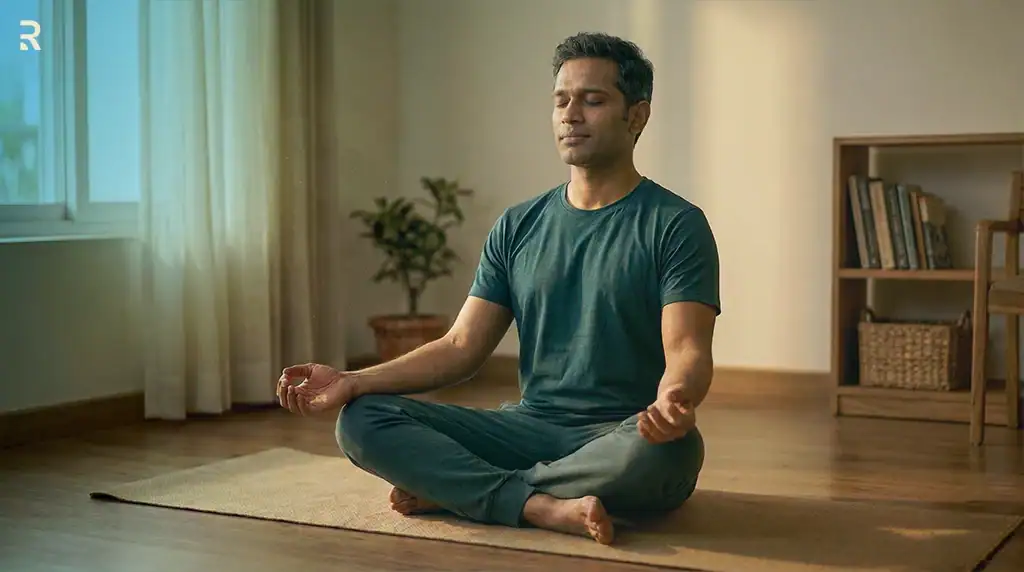
Padmasana is a meditation seat. Its value for PE is the calm focus it supports. Caution: it is hard on the knees. If your knees protest, sit in Sukhasana (simple cross-legged) instead; the benefit comes from the stillness, not the leg position.
6. Paschimottanasana (Seated Forward Bend)
- Sit with both legs straight in front of you and raise your arms as you breathe in.
- Breathing out, fold forward from the hips and hold your shins, ankles or feet, whichever you reach comfortably.
- Hold for 20 to 30 seconds, breathing slowly. Keep a slight bend in the knees if the backs of your legs are tight.
It stretches the back and hamstrings and has a calming effect on the mind. Caution: avoid deep bending with a slipped disc or sciatica.
7. Sarvangasana (Shoulder Stand)
- Lie on your back with a folded blanket under your shoulders.
- Lift your legs and hips, supporting your lower back with your hands, until your legs point up.
- Keep your weight on your shoulders, not your neck. Hold for 15 to 30 seconds, then roll down slowly.
Older texts claim this pose "balances the thyroid". There is no good evidence for that, so treat it as a strength and relaxation pose only. Caution: do not do it with neck or spine problems, high blood pressure, glaucoma or heart disease. Learn it from a teacher first.
8. Halasana (Plough Pose)
- From the shoulder stand, slowly lower your feet over your head towards the floor behind you.
- Rest your toes on the floor if you can, or on a chair, keeping your arms on the mat.
- Hold for 10 to 20 seconds, then roll your spine down one section at a time.
It gives the back and hamstrings a deep stretch. Caution: the same cautions as the shoulder stand apply. Beginners can skip both inversions without losing much.
9. Ardha Matsyendrasana (Half Spinal Twist)
- Sit with legs straight. Bend your right knee and place your right foot on the floor outside your left knee.
- Turn your upper body to the right, placing your right hand behind you and your left elbow outside your right knee.
- Hold for 20 to 30 seconds, breathing steadily, then repeat on the other side.
A twist that keeps the spine and hips mobile and eases lower back tension. Caution: twist gently if you have a spinal injury or recent abdominal surgery.
10. Shavasana (Corpse Pose)
- Lie flat on your back with your arms by your sides, palms up, and feet falling open.
- Close your eyes and relax each part of the body in turn, from toes to head.
- Stay for 5 to 10 minutes, letting your breathing slow down on its own.
It looks like doing nothing, but deep relaxation is exactly what an over-alert nervous system needs. The AIIMS programme included a similar guided relaxation, yoga nidra, twice a day.
| Practice | Main focus | Skip or modify if you have |
|---|---|---|
| Vajrasana | Stable seat, pelvic awareness | Knee or ankle pain |
| Ashwini Mudra | Pelvic floor control | Pelvic pain (see a doctor) |
| Dhanurasana | Hip and back stretch | Back pain, hernia, high BP, recent surgery |
| Bhujangasana | Hip opener, back strength | Back injury, hernia, recent surgery |
| Padmasana | Calm focus | Knee problems (use Sukhasana) |
| Paschimottanasana | Back stretch, calming | Slipped disc, sciatica |
| Sarvangasana | Strength, relaxation | Neck or spine problems, high BP, glaucoma, heart disease |
| Halasana | Deep back stretch | Same as Sarvangasana |
| Ardha Matsyendrasana | Spine and hip mobility | Spinal injury, recent surgery |
| Shavasana | Deep relaxation | Nothing; suits everyone |
Which breathing practices and mudras help?
Slow breathing practices such as Anulom Vilom and belly breathing calm the stress response that speeds up ejaculation, and breathing work was part of every trial programme. Ashwini Mudra is the one mudra with trial use; hand mudras have no research behind them for PE.
If anxiety is a big part of your problem, it helps to understand how stress and anxiety cause premature ejaculation. Breathing is the most direct tool you have against that loop.
Anulom Vilom (alternate nostril breathing)
Sit comfortably. Close your right nostril with your right thumb and breathe in through the left. Close the left nostril with your ring finger, release the right, and breathe out through it. Breathe in through the right, switch, and breathe out through the left. That is one round. Do 5 to 10 minutes, slowly and without strain. The AIIMS programme used this practice, called Nadi Shodhan, three times a day.
Slow belly breathing
Place one hand on your stomach. Breathe in through your nose for about four counts so your belly rises, then out for about six counts. A longer out-breath is what calms the body. This is also the one practice you can use during sex: when you feel yourself nearing the point of no return, slow down, breathe deeply into the belly and relax the pelvic muscles instead of clenching.
Kapalbhati, with care
Kapalbhati uses short, forceful out-breaths driven by the stomach muscles. Many men try it from YouTube videos, but it is not gentle. Avoid it if you have high blood pressure, heart disease, a hernia, epilepsy or recent abdominal surgery, and learn it from a trained teacher. It is optional; the slow practices above matter more for PE.
Mula Bandha and Vajroli Mudra
Mula Bandha is a steady, held lift of the pelvic floor, a longer version of the Ashwini squeeze. Vajroli Mudra, a more targeted contraction of the muscles around the urethra, was part of the AIIMS Rishikesh protocol. Both are advanced, easy to do wrongly, and best learned from an experienced teacher. Hand mudras shown online as a cure for PE have no research behind them.
How long should you practise, and when will you see results?
Reviews suggest about an hour a day in total: 20 to 40 minutes of poses, around 10 minutes of breathing and a few minutes of relaxation. Start with 20 to 30 minutes and build up. In the Indian trials, lasting time improved steadily over weeks, so judge your progress at 12 weeks, not after a few days.
Joshi and colleagues recommend roughly this daily dose based on the trial programmes (Joshi et al., 2020). In the AIIMS study, the yoga group was practising twice a day, and the full benefit showed at the 12 week mark. That is slower than medicine, which can work within days. Knowing this at the start stops you from giving up in week two.
A simple daily routine
- Warm up (5 minutes): neck rolls, shoulder circles, gentle side bends and marching on the spot.
- Vajrasana with Ashwini Mudra (5 minutes): sit tall, then do 10 slow squeezes and releases.
- Backbends (5 minutes): Bhujangasana, then Dhanurasana, resting between them.
- Forward bend (2 minutes): Paschimottanasana.
- Inversions (3 minutes, only if you have no cautions): Sarvangasana, then Halasana.
- Twist (2 minutes): Ardha Matsyendrasana on both sides.
- Breathing (10 minutes): Anulom Vilom, then slow belly breathing, seated in Padmasana or Sukhasana.
- Relaxation (5 to 10 minutes): Shavasana.
Early morning on an empty stomach works best, or wait about 3 hours after a meal. Add two short Ashwini Mudra sets later in the day if you can. Consistency beats intensity: 30 minutes every day will do more than two hours on a Sunday.
Yoga, ayurveda and "instant cures" in India: what should you know?
Yoga is one of the better-grounded home options for PE in India, because most of its research comes from Indian hospitals, it costs almost nothing and it can be done privately at home. The problem is what often comes alongside it: powders, oils and clinic promises with no evidence at all.
Because of embarrassment, many Indian men try everything else before seeing a doctor. A friend's advice, a YouTube routine, an ayurvedic powder, a roadside "sex clinic" or a neem-hakeem who promises a "permanent cure in 7 days". Some things worth knowing:
- Privacy is easier than you think. In a joint family, an early morning routine in your room raises no questions. Yoga needs a mat and 30 minutes, nothing else.
- "Instant" or "permanent" promises are false. No yoga routine, oil, capsule or clinic can guarantee a permanent fix in days. The trials took 12 weeks of daily work to show results.
- Ashwagandha and shilajit have thin evidence for PE. Some unregulated "herbal" sexual health products sold in India and abroad have been found to contain heavy metals or hidden prescription drugs. Our guide to home remedies for premature ejaculation goes through each popular remedy and what the evidence says.
- Do not stop prescribed medicine to switch to yoga. If a doctor has put you on treatment, add yoga alongside it and discuss any change with them.
- PE and erection problems often travel together. If you also struggle with erections, yoga can support general fitness, but have the erection problem checked too. Our guide to exercises for erectile dysfunction covers what helps there.
When should you see a doctor?
See a doctor if you have had PE since your first sexual experience, if it comes with erection problems, if it started suddenly after years of normal control, or if 12 weeks of regular yoga has not helped. These patterns often point to a cause that yoga cannot fix on its own.
Also get help sooner if you notice any of these:
- pain during or after ejaculation, or burning while passing urine
- blood in your semen
- signs of a thyroid problem, such as weight change, a racing heart, tremors or constant tiredness
- PE that is causing distress, anxiety, low mood or strain in your relationship
- a known condition such as diabetes or high blood pressure
A doctor will ask about your history, check for a physical cause and may order simple blood tests. Treatment depends on the cause. Mainstream options include behavioural techniques such as the stop-start and squeeze methods, counselling, SSRI medicines such as dapoxetine, and numbing creams or sprays containing a local anaesthetic (NHS). Medicines should be used only on a doctor's prescription, never bought over the counter on a friend's advice. Yoga fits comfortably alongside any of these.
There is nothing to be embarrassed about. PE is a medical issue like any other, and doctors see it every day.
So, should you try yoga for premature ejaculation?
Yes, if you go in with the right expectations. Yoga is safe for most men, costs nothing, and has encouraging Indian research behind it. Give it 12 weeks of daily practice, respect the cautions, and combine it with slow breathing during sex. Just do not let it become a reason to delay a check-up if something else is going on.
The fastest way to know whether yoga alone is enough is to find out what is driving your PE. Raaz doctors have carried out 50,000+ doctor consultations, and "97% users saw results". Take the free Men's Test: it takes about 2 minutes, it is private, and it is the first step towards a plan built around your root cause rather than guesswork.
Frequently asked questions
Can yoga cure premature ejaculation permanently?
No study shows that yoga cures premature ejaculation for good. Small Indian trials found that men who practised yoga daily for 12 weeks lasted noticeably longer, some as well as men on medicine. But the studies were small and short, and yoga cannot fix a thyroid, prostate or erection problem behind PE. Treat it as a useful part of treatment, not the whole of it, and keep practising to keep the benefit.
Which yoga is best for premature ejaculation?
No single pose has been proven best, because the trials tested full programmes of poses, breathing and relaxation, not one asana. Practices that work the pelvic floor, such as Ashwini Mudra in Vajrasana, plus calming ones like Anulom Vilom and Shavasana, form the core of most programmes. A steady daily routine matters far more than finding the perfect pose.
Which mudra is best for premature ejaculation?
Ashwini Mudra is the most widely used. It means rhythmically tightening and relaxing the muscles around the anus, which trains the same pelvic floor muscles as Kegel exercises. An AIIMS Rishikesh study included Ashwini and Vajroli Mudra three times a day. Hand mudras have no research behind them for PE, and Vajroli should only be learned from a trained teacher.
Is yoga better than tablets for premature ejaculation?
Not better, but a real option. In two Indian studies, yoga improved lasting time about as much as the SSRI medicines fluoxetine and paroxetine over 12 weeks, with no significant side effects. It takes weeks to work, though, and the studies were small and not randomised. Medicines act faster but need a doctor's prescription after your cause is checked. Many men do well with both together.
Does yoga help erectile dysfunction as well?
It may. Some studies suggest benefits for erections too, though the evidence is weaker than for PE. Yoga improves fitness, blood flow and stress, which all matter for erections. But erection problems can be an early sign of diabetes, high blood pressure or heart disease, so get them checked by a doctor instead of relying on yoga alone.
Can I do yoga and Kegel exercises together?
Yes, and it is a sensible combination. Kegel exercises for premature ejaculation train the pelvic floor directly, while yoga adds relaxation, breathing control and overall fitness. Ashwini Mudra is basically a yogic Kegel, so avoid overworking the same muscles: a few short sets a day with rest in between is enough. If you feel pelvic pain, stop and speak to a doctor.