
Is premature ejaculation normal? Yes. Finishing sooner than you wanted now and then happens to almost every man, and premature ejaculation (PE) is the most common sexual problem men face. It becomes a medical condition only when it happens nearly every time, you cannot delay it, and it causes you or your partner real distress.
Raaz MD's doctors hear some version of "Am I normal?" almost every day, usually after months of worrying alone and reading scary things online. Below we go through the eight myths we hear most often in India, what the evidence actually says about each one, and when it makes sense to get help. If you already know you want to fix the problem, our guide to premature ejaculation treatment options covers every medical and non-medical route in detail.
Is premature ejaculation normal?
Myth 1: "PE is rare, so something must be wrong with me." The fact: premature ejaculation is extremely common. The Victorian Government's Better Health Channel puts it at between 1 in 3 and 1 in 5 men aged 18 to 59, and calls it the most common sexual problem in the world.
At Raaz, where our doctors have held 50,000+ consultations, we put it simply: "1 in 4 men struggle with ED and PE". So if you finished early last night, or have been finishing early for a while, you are in very large company.
What separates an occasional early finish from a condition is pattern and distress. One quick night after a long gap, a few drinks or a stressful week means nothing. Finishing within a minute or two almost every time, for months, while feeling frustrated or avoiding sex because of it, is worth attention. Even then, it is a treatable problem, not a sign that your body is broken.

Why does premature ejaculation feel so rare in India?
Because almost nobody talks about it. In many Indian homes, sex is not discussed at all, and sexual health problems are still called "gupt rog", literally a secret illness. Friends joke about stamina but rarely admit to struggling. So each man assumes he is the only one.
- Silence at home: in a joint family, there is little privacy to talk to a partner, let alone see a doctor.
- Marriage pressure: many men have their first sexual experiences soon after marriage, with high expectations and high nerves, which is exactly when early ejaculation is most likely.
- The wrong first stop: roadside "sex clinics", neem-hakims and social media ads that promise a "shartiya ilaj" (guaranteed cure) are often a man's first contact. They profit from making the problem sound rare and serious.
None of this changes the medical reality: PE is common, it is not your fault, and it can be treated.
Does premature ejaculation only happen to older men?
Myth 2: "Only older men get PE." The fact: it can happen at any age, and lifelong PE usually shows up in a man's first sexual experiences, often in his late teens or twenties. Younger men with little experience and a lot of excitement commonly finish quickly.
Age still matters, just differently. PE that starts later in life, after years of normal control, is called acquired PE. It is more often linked to a physical or emotional change: a thyroid problem, difficulty getting or keeping erections, a stressful job, a new relationship or prostate inflammation. That is why a sudden change deserves a check-up rather than a shrug.
How long should a man last in bed?
Myth 3: "A normal man lasts 20 to 30 minutes." The fact: most men last far less. In a stopwatch study of about 500 couples across five countries, Waldinger and colleagues found the median time from penetration to ejaculation was about 5.4 minutes, with a very wide spread between men.
The 20 to 30 minute idea mostly comes from porn, which is edited, staged and performed by people chosen for exactly that. It also comes from friends' boasting, which is rarely timed with a stopwatch. Comparing yourself with either sets you up to feel like a failure when you are actually average.
Doctors do not diagnose PE on a single number. The International Society for Sexual Medicine (ISSM) definition needs three things together: a short time to ejaculation, being unable to delay it on all or nearly all occasions, and negative personal effects such as distress, frustration or avoiding intimacy.
| Situation | Typical timing | What it means |
|---|---|---|
| Occasional early finish | Varies; quick now and then | Normal. Often linked to excitement, a long gap, a new partner or stress. |
| Lifelong PE | Always or nearly always within about 1 minute of penetration, since your first sexual experiences | A recognised condition. Very treatable with techniques, counselling and, if needed, prescription treatment. |
| Acquired PE | A clear, bothersome drop in your usual time, often to about 3 minutes or less | Started after years of normal control. Look for a cause such as erection problems, thyroid, stress or a relationship change. |
| Variable PE | Early some times, fine at others | Usually a normal variation, not a disorder. Reassurance and simple techniques often help. |
| Feeling you finish "too soon" at an average time | Within the normal range, such as 4 to 8 minutes | Not PE by definition. Often about expectations, which a frank conversation can fix. |
If your timing is in the normal range but you still want more control, that is a fair goal too. Our guide covers practical, evidence-based ways to last longer in bed without pills.
Does masturbation or nightfall cause premature ejaculation?
Myth 4: "Masturbation in my teens, or nightfall, has made me weak and caused PE." The fact: there is no scientific evidence that masturbation, at any age, or nightfall (nocturnal emission or wet dreams) causes premature ejaculation, weakens the body or reduces "vital energy". Both are normal parts of male sexuality.
This myth has deep roots in India. An old belief holds that semen is made from many drops of blood and that losing it drains strength. Psychiatrists even have a name for the anxiety it causes: dhat syndrome. A review in the Indian Journal of Psychiatry traces how this semen-loss belief runs through Indian culture and still brings young men to clinics with fatigue, guilt and worry about their sexual performance.
The belief is powerful precisely because it is so widely repeated. Many unqualified clinics blame "childhood mistakes" and then sell expensive powders to "restore" what was supposedly lost. The truth is simpler: your body keeps making sperm throughout life, and nothing you did as a teenager used it up.
What can happen is the reverse of the myth. Guilt and anxiety about masturbation can make a man tense during sex, and anxiety itself can speed up ejaculation. Some men also train themselves to finish quickly by always rushing through masturbation, which can become a habit. That is a learnt pattern, not damage, and it can be unlearnt. If nightfall itself worries you, read our doctor's guide to nightfall: causes and treatment.
Does premature ejaculation mean you are infertile or less of a man?
Myth 5: "PE means I cannot have children and I am not a real man." The fact: premature ejaculation does not affect sperm count or sperm quality, and it says nothing about your masculinity. Fertility depends on how many healthy sperm your testes make and how well they move, which is a completely separate system from the timing of ejaculation.
If ejaculation happens inside the vagina, pregnancy is possible however quickly it happens. Only in the uncommon situation where a man regularly ejaculates before penetration can PE make conception harder, and even that has solutions a doctor can discuss.
The "real man" idea is a social belief, not a medical one. Stamina in bed is not a measure of strength, character or worth. Yet the shame is real, and it causes most of the damage. Many men with PE start avoiding intimacy, making excuses at bedtime, or pulling away from their partner without explaining why. Partners often misread that distance as a loss of interest.
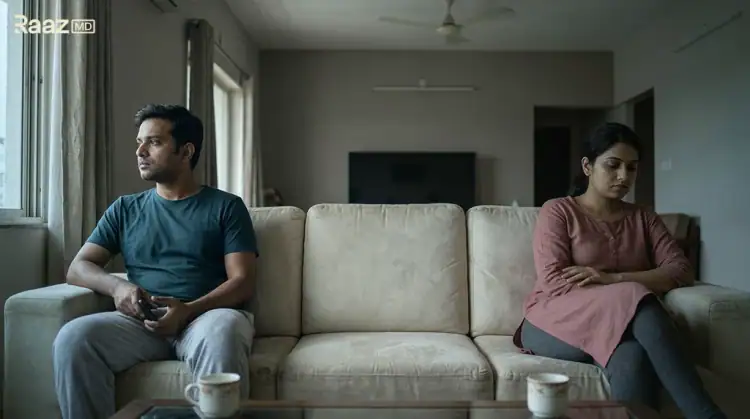
The most useful step is often the hardest one: talking to your partner. When she understands it is a common medical issue and not about her, the pressure drops, and lower pressure alone helps many men last longer.
Is premature ejaculation all in the mind? What actually causes it
Myth 6: "PE is purely psychological, so I just need to relax." The fact: PE is rarely only in the mind or only in the body. Stress and performance anxiety matter a great deal, but so do hormones, penile sensitivity, erection problems, sleep and general health, and in many men more than one cause is at work.
This is the core of how we work at Raaz. The same climax problem can have very different root causes in two different men. One may be anxious and sleeping four hours a night. Another may have an underactive or overactive thyroid. A third may be rushing because he is worried about losing his erection. Giving all three the same pill misses the point. Finding the cause is what makes treatment work.
Stress, anxiety and sleep
Performance anxiety creates a loop: you worry about finishing early, the worry raises your arousal and tension, and you finish early, which feeds the worry. Work stress, money pressure, depression and poor sleep all make control harder. Read more on how stress and anxiety affect ejaculation and what breaks the loop.
Hormones: thyroid and testosterone
Thyroid problems are one of the best-known physical causes of acquired PE, particularly an overactive thyroid. Testosterone and other hormones also influence desire and ejaculatory control. A simple blood test can rule these in or out. Our guide to thyroid and sexual problems in men explains the link.
Penile sensitivity and erection problems
Some men have a more sensitive penis or a more easily triggered ejaculation reflex, which may partly run in families in lifelong PE. Separately, men who struggle to keep an erection often rush to finish before it fades, and over time that rushing becomes PE. Inflammation or infection of the prostate can also play a part.
Habits and health: smoking, alcohol, gutkha, diabetes
Smoking, gutkha and other tobacco, heavy drinking, diabetes, high blood pressure and high cholesterol harm blood vessels and nerves. They are best known for causing erection problems, and erection problems commonly travel with PE. Poor nutrition, obesity and a sedentary routine add to the load.
Is premature ejaculation the same as erectile dysfunction?
No. Premature ejaculation is about control over when you climax. Erectile dysfunction (ED) is about getting or keeping an erection firm enough for sex. They are different conditions, but they often exist together, and treating an underlying erection problem can improve control too. Sildenafil and tadalafil are ED medicines, not PE medicines, and should only be taken on a doctor's prescription. Never take them with nitrate medicines for chest pain (such as nitroglycerin or isosorbide), and check with a doctor first if you have heart disease or low blood pressure.
Not sure which of these is behind yours? The free Raaz Men's Test takes about 2 minutes, is completely private, and helps pinpoint the likely root cause so a doctor can look at what is actually driving your symptoms.
Do you just have to live with premature ejaculation?
Myth 7: "PE is permanent, nothing works, so I just have to live with it." The fact: premature ejaculation is treatable, and most men improve with the right approach. There is no need to accept it as your fate, whatever your age.
What works depends on the type and the cause, and a combination usually works best:
- Behavioural techniques: the stop-start and squeeze methods train you to recognise the point of no return and pull back from it. They take practice but cost nothing.
- Pelvic floor exercises: strengthening these muscles can improve control. Our step-by-step guide to Kegel exercises for premature ejaculation shows how.
- Counselling or sex therapy: alone or with your partner, especially when anxiety, relationship strain or past experiences are involved.
- Prescription medicines: a doctor may consider dapoxetine or certain other SSRI medicines, or a numbing (anaesthetic) cream or spray. These are only suitable on a doctor's prescription, after checking your health and other medicines.
- Treating the root cause: fixing a thyroid problem, an erection problem, poor sleep or heavy drinking often improves acquired PE on its own.
Lifelong PE usually needs ongoing management rather than a one-time fix, while acquired PE often improves a great deal once its cause is dealt with. Honest doctors will not promise a "100% permanent cure", but they will help you get to a point where it stops controlling your life. For the full picture, see our complete guide to premature ejaculation treatment options.
Do ayurvedic medicines, shilajit or sprays cure premature ejaculation?
Myth 8: "Herbal is natural, so an ayurvedic capsule or shilajit will cure PE safely." The fact: no remedy sold as a PE cure, including ashwagandha, shilajit or safed musli products, has good-quality trial evidence that it treats premature ejaculation. "Natural" also does not mean safe.
In 2023, Indian liver specialists led by Dr Cyriac Abby Philips at Rajagiri Hospital, Kochi, published a case series of liver injury linked to ashwagandha in people from India. Loose "herbal" sex capsules sold online or at roadside stalls add another problem: you have no way of checking what is actually inside them.
| Remedy | What it claims | What the evidence shows | Real risk |
|---|---|---|---|
| Ashwagandha | Stamina, stress relief, "cures" PE | Some studies on stress and sperm quality; no reliable trials showing it treats PE | Reported liver injury; may affect thyroid levels and interact with other medicines |
| Shilajit | Strength, testosterone, lasting longer | Very limited human research; nothing solid for PE | Raw or poorly processed products may be contaminated |
| Safed musli and "herbal" sex capsules | Quick, guaranteed results | No good-quality trials for PE; contents often unverified | Unknown ingredients; money and months lost; delays proper care |
| Numbing sprays and creams | Delay ejaculation | Anaesthetic products can help some men | Numbness for you or your partner; best used with a doctor's advice |
| Alcohol before sex | "Relaxes" you so you last longer | Dulls sensation briefly but is not a treatment | Harms erections, and regular drinking worsens sexual health |
Sensible lifestyle changes, such as better sleep, regular exercise, less alcohol and quitting tobacco, genuinely support sexual health. They are not a quick cure, but they help. Read our honest guide to what home remedies can and cannot do before spending money on any product.
When should you see a doctor about premature ejaculation?
See a doctor if early ejaculation happens almost every time you have sex, has gone on for several months, started suddenly after years without it, or is causing stress or distance in your relationship. A doctor can look for causes you cannot see yourself, such as a thyroid problem, low testosterone or difficulty with erections.
It is worth booking a consultation if any of these apply:
- You ejaculate before or within about a minute of penetration on most occasions.
- Your usual time has dropped sharply and you do not know why.
- You also have trouble getting or keeping an erection.
- You have pain, burning or discomfort when ejaculating or passing urine.
- You have diabetes, thyroid disease, high blood pressure or take regular medicines.
- You are avoiding sex, feel low, or it is affecting your relationship.
- You have spent money on remedies that did not work.
A good doctor will ask about your history, your timing and your health, may examine you or order a few blood tests, and will not judge you. This is routine work for them. Here is what happens when you see a doctor for PE, including which specialist to choose. With Raaz, the whole consultation can happen privately online, from home. A good private first step is the free 2-minute Men's Test, which a doctor can build on in your consultation.
The bottom line
Finishing early now and then is normal. Finishing early nearly every time is common, has real causes, and is treatable. It is not caused by masturbation or nightfall, it does not make you infertile, and it does not make you less of a man. The worst thing you can do is stay silent or hand your money to someone promising a guaranteed herbal cure.
Most men who get the right help for PE see it improve. At Raaz, we look for the root cause behind your symptoms, whether that is stress, hormones, an erection problem or lifestyle, instead of handing everyone the same pills. Start with the free Men's Test: it takes about 2 minutes, it is completely private, and it is the first step towards a plan built for you.
Frequently asked questions
Is premature ejaculation normal the first time or in your teens?
Yes. Finishing quickly the first time, the first few times with a new partner, or during your teens and early twenties is very common, because excitement and nerves are both high. It does not mean you have a lasting problem. Control usually improves with experience and a relaxed, familiar partner. If it keeps happening on nearly every attempt over several months and it upsets you or your partner, that is the point to speak to a doctor.
Is premature ejaculation a disease?
Not in the sense of damage or infection. Doctors class premature ejaculation as a common sexual dysfunction: a problem with control over ejaculation, not a disease of the penis or reproductive organs. It can come from anxiety, hormones such as thyroid, penile sensitivity or erection problems, and lifelong PE may partly run in families. It does not spread to a partner, and it is treatable.
Can premature ejaculation go away on its own?
Sometimes. PE that comes and goes, for example with a new partner, after a long gap or during a stressful phase, often settles as confidence and routine return. Lifelong PE, present since your first sexual experience, rarely goes away without help. Techniques, counselling and prescription treatment work well for most men, so there is no need to simply wait and hope for months or years.
Can a man with premature ejaculation get his partner pregnant?
Yes, in most cases. PE does not affect sperm count or sperm quality. As long as ejaculation happens inside the vagina, pregnancy is possible even if it happens quickly. Only when ejaculation regularly happens before penetration can it make conception harder, and a doctor can help with that too. If you are trying for a baby and it is not happening, a semen test answers the fertility question directly.
Is premature ejaculation bad for your health?
Not physically. PE does not damage your body, your sperm or your future erections. The real harm is emotional: stress, low confidence, avoiding intimacy and strain in the relationship. Sometimes it is also a signal of something worth checking, such as a thyroid problem or difficulty with erections, which is why a quick check with a doctor is sensible if it persists for months.
Is premature ejaculation common in India?
Yes. At Raaz, we see that "1 in 4 men struggle with ED and PE", and international health sources put PE at 1 in 3 to 1 in 5 men aged 18 to 59. It only seems rare in India because men seldom talk about it with family, friends or even partners, and many visit unqualified clinics or buy online capsules before they ever see a qualified doctor.